

Let’s cut straight to it.
Most business websites are underperforming.
Not because the business is weak.
Not because the offer is bad.
Not because there is no demand.
They’re underperforming because the website is acting like a brochure when it should be acting like a closer.
And that matters more than most business owners realise.
Because while you’re leading the team, delivering the service, managing operations, handling sales, fixing problems, and trying to keep momentum moving, your website should be out there doing serious work on your behalf.
It should be building trust
It should be answering questions
It should be removing hesitation
It should be showing proof
And above all, it should be turning attention into action
That is the real job.
A website is not there to simply look polished. It is there to help drive revenue.
Think about your best employee for a second.
The one who knows how to explain what you do clearly. The one who makes people feel confident. The one who handles objections without making it awkward. The one who knows how to guide the next step and make a prospect feel like they’re making a smart decision.
Now ask yourself this:
Is your website doing any of that?
Because it should be.
A strong website is the one part of your business that can greet a potential client at 6:30 in the morning, midnight, or during someone’s lunch break, walk them through what you offer, show them why you’re worth trusting, and make it easy for them to take action, all without needing a single person on your team to be present.
That’s not a nice bonus.
That’s leverage.
Here’s What This Looks Like in the Real World
Let’s say you run a professional service business.
A prospect lands on your website after hearing about you through a referral or finding you through search. They’re interested, but they’re cautious. They want to know whether you’re credible, whether you understand their problem, and whether working with you is worth the investment.
If your website gives them vague messaging, generic claims, no clear process, no examples, no proof, and no obvious next step, you create doubt.
And doubt kills momentum.
Not because they didn’t need what you offer.
Because your website didn’t give them enough confidence to move forward.
Now flip it.
They land on a homepage that clearly says who you help and what outcome you deliver. They see real client results. They understand your process. They read testimonials that sound like people in their exact position. They know what the next step is and what happens after that.
Now they’re not just browsing.
Now they’re considering.
Same business. Same prospect. Different website. Different result.
That’s what a high-performing website does. It moves people from uncertainty to action.
Pretty Is Not The Same As Persuasive
This is where a lot of businesses get stuck.
They invest in a website that looks clean, modern, and professional, but nobody asks the harder question:
Is it converting?
Because a good-looking website that doesn’t generate enquiries, calls, or sales is still a weak asset.
You do not need a website that makes other business owners say, “Nice site.”
You need a website that makes a prospect think:
- These people know what they’re doing
- They understand the problem
- I trust them
- I’m ready to take the next step
That is the standard.
Whether you run a consultancy, agency, clinic, trade business, legal practice, finance firm, coaching business, or service-based company, the job is the same: your website should help turn interest into action.
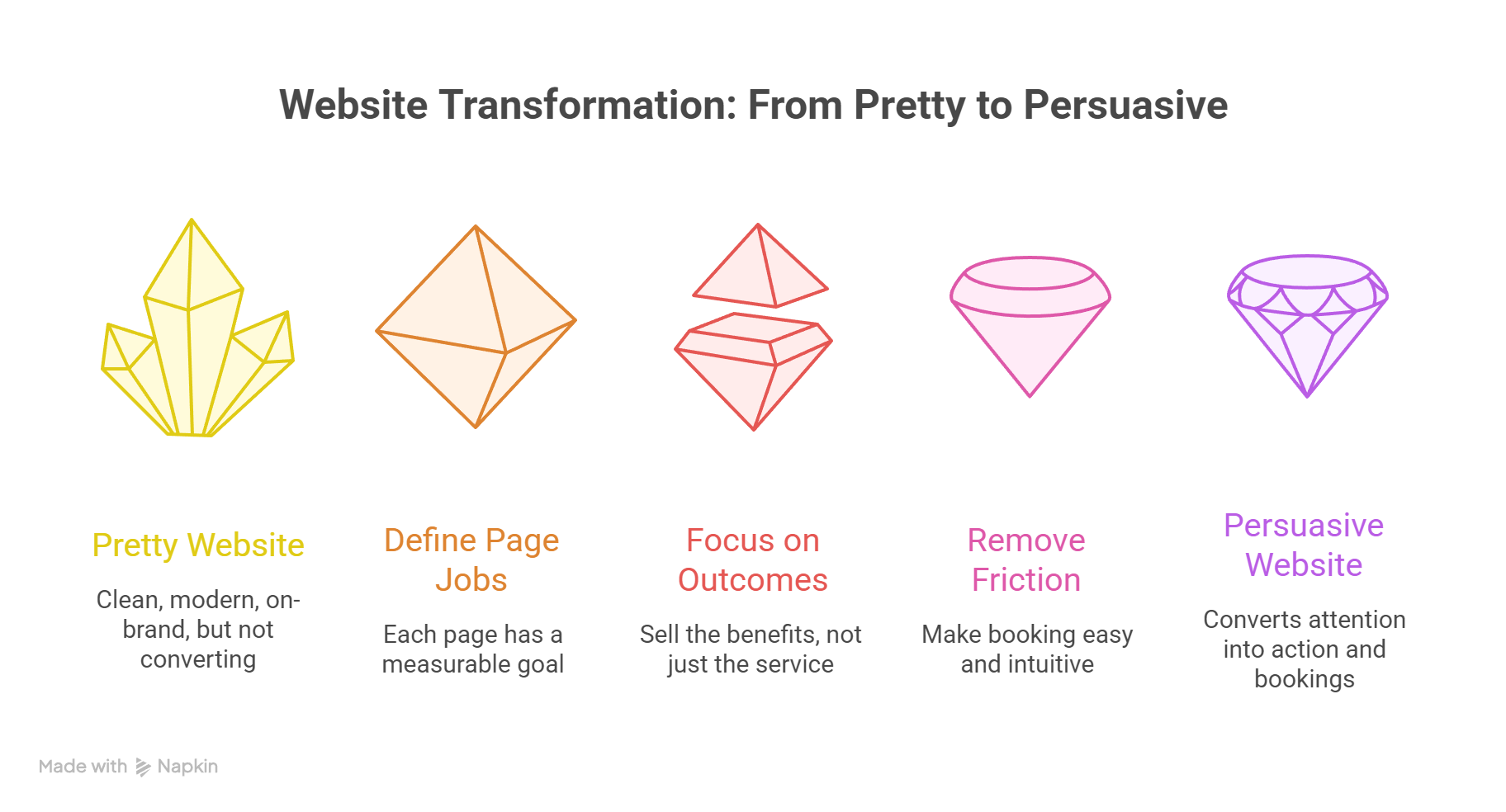
Every Page Should Have A Job
This is where direct response thinking changes everything.
Every page on your website should be earning its place.
Your homepage should make a strong first impression and direct people where to go next
Your service pages should build desire and reduce hesitation
Your about page should build credibility and connection.
Your testimonials should provide proof
Your contact page should remove friction.
If a page is vague, passive, confusing, or generic, it is costing you.
That may sound blunt, but it’s true.
For example, here’s a weak headline:
“We provide tailored solutions for businesses across a range of industries.”
Technically fine. Completely forgettable.
Now compare it to this:
“We help growing businesses fix the bottlenecks that cost them time, clients, and revenue.”
That lands differently.
It is clearer. Sharper. More outcome driven.
Or take this one:
“Our team is passionate about delivering excellence and client satisfaction.”
Everybody says that.
Now compare it to:
“From the first conversation to final delivery, we focus on one thing: making it easy for clients to get results without the usual mess, delays, or confusion.”
That does more work.
Because outcomes are what people buy.
They do not buy consulting because they want consulting.
They buy clarity, growth, better systems, or fewer headaches.
They do not buy legal services because they want paperwork.
They buy protection, confidence, and reduced risk.
They do not hire a marketing agency because they want “marketing.”
They hire one because they want leads, sales, momentum, and a return.
Your website should reflect that reality.
Great Websites Also Reduce Workload
This part gets overlooked all the time.
A hard-working website does not just bring in opportunities. It also makes the business easier to run.
It answers common questions before somebody has to ask them.
- What exactly do you do?
- Who is this for?
- What does the process look like?
- How long does it take?
- What are the likely costs?
- What happens after I enquire?
- Are you the right fit for this kind of work?
When your website does not answer those questions, your team ends up doing it manually through calls, emails, DMs, and back-and-forth messages.
That is inefficient.
A stronger website filters out poor-fit leads, pre-qualifies better ones, and helps the right people arrive ready for the conversation.
That is exactly what a valuable employee would do.
Proof Matters More Than Claims
You can say you’re experienced.
You can say you care.
You can say you deliver quality.
Everybody says that.
Proof is what moves the needle.
- That might mean case studies.
- It might mean testimonials.
- It might mean clear numbers.
- It might mean recognisable clients.
- It might mean before-and-after examples, measurable outcomes, or a sharp, credible process.
A site that says, “We pride ourselves on exceptional service” is making a claim.
A site that says, “Trusted by over 200 clients to simplify operations, improve conversions, and create better customer experiences” is starting to build belief.
One is filler.
The other is evidence.

Your website should be selling while you work
A prospect might land on your website while sitting in a meeting they’ve mentally checked out of. On a train home. Late at night. First thing in the morning. Right after they’ve hit a pain point and decided they need help.
You are not always available in those moments.
Your website is.
So the question becomes: what is it doing with that opportunity?
Is it passively existing?
Or is it actively converting?
Because there is a massive difference.
Welcome
Qualify
Persuade
Reassure
And guide the next step
Not aggressively. Not awkwardly. But clearly.
And if it isn’t doing that, there’s a good chance it’s leaving opportunities on the table.
That does not mean your business is broken.
It means your website may not be pulling its weight.

The good news? That can be fixed.
Sharper copy
Clearer structure
Stronger proof
Better calls to action
Less fluff
More conviction
That is how a website starts working like an asset instead of sitting there like digital décor.
If your website looks decent but is not bringing in the volume or quality of enquiries you want, it is worth taking a closer look.
Request a website audit and find out where your site is losing trust, creating friction, or failing to convert.
Because your website should not just sit there.
It should be one of the hardest working parts of your business.